7 Mistakes to Avoid When Driving in Korea
7 Mistakes to Avoid When Driving in Korea
🚫 Turning Right on Red Without Stopping
One of the first things that can confuse foreign drivers in Korea is turning right at a red light.
In Korea, a red traffic light does not always mean that a right turn is completely prohibited. However, that does not mean you can simply slow down and turn.
If the traffic light is red, you should first come to a complete stop before the stop line or crosswalk. Then, check carefully for pedestrians and other vehicles before making the turn when it is safe.
If a pedestrian is crossing or clearly about to cross, you must wait and let them pass safely.
Some intersections also have a separate right-turn traffic signal. In that case, you must follow the right-turn signal. If the right-turn signal is red, you cannot turn right.
The basic rule is simple:
Red light → Come to a complete stop → Check for pedestrians and traffic → Turn only when it is safe
There is also another situation you may encounter while driving in Korea.
What if the driver behind you honks because they want to turn right?
You may be waiting at a red light in a lane that allows both going straight and turning right, while the driver behind you wants to turn right.
If you are unfamiliar with Korean roads, you might wonder:
“Am I blocking the lane?”
“Do I need to move out of the way?”
No.
If you are in a lane where going straight is allowed and you are waiting for the green light, you are using the lane normally. You do not have to move just because the driver behind you wants to turn right.
Do not pull forward beyond the stop line or into the crosswalk just to make room for the car behind you. You also do not need to make a sudden lane change simply because someone is honking.
Even if the driver behind you becomes impatient, follow the traffic signal and wait until you can proceed safely.
The traffic signal matters more than the horn behind you.
Likewise, do not automatically follow the car in front of you just because it turns right on red. And do not rush just because the driver behind you is pressuring you.
When turning right in Korea, the most important thing is to check the traffic signal, pedestrians, and surrounding traffic yourself rather than simply copying what other drivers are doing.
🚫 Misunderstanding an “Unprotected Left Turn”
In Korea, left turns are usually made by waiting for a green left-turn arrow. When the green arrow appears, you can proceed with the turn.
However, at some intersections, there is no separate left-turn signal. Instead, you may see a blue sign near the traffic light with the Korean word ‘비보호’.
If you plan to drive in Korea, this is one Korean word worth remembering.
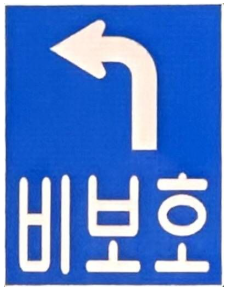
The word “unprotected” can make it sound as if you are free to turn whenever the road looks clear, but that is not what it means.
An unprotected left turn is allowed only when the straight-ahead traffic light is green. You must check oncoming traffic and pedestrians yourself, and turn only when it is safe.
The most important thing to remember is that a green light does not give the left-turning vehicle the right of way.
If there are vehicles coming straight toward you, you need to wait for them to pass. Make the turn only when there is enough space to do so safely.
A simple way to remember it is:
Green left-turn arrow → Follow the left-turn signal
‘비보호’ sign → Turn left only when the straight-ahead light is green, after checking oncoming traffic and pedestrians. Do not turn left on red.
If you are driving in Korea for the first time, simply recognizing the Korean word ‘비보호’ near a traffic light can be very helpful.
“Unprotected” does not mean “turn whenever you want.”
Think of it as a left turn where you are responsible for checking oncoming traffic and making sure it is safe before you go.
🚫 Making a U-Turn Without Checking When It’s Allowed
In Korea, places where U-turns are allowed are usually marked clearly with U-turn road markings or signs, so it is relatively easy to see where you can make one.
But the more important question is not just “Can I make a U-turn here?” It is “Am I allowed to make one right now?”
At some U-turn locations in Korea, an additional sign is posted below the main U-turn sign. This sign shows the specific traffic-signal condition under which the U-turn is allowed.
For foreign drivers, this can be the confusing part. The U-turn symbol itself is easy to recognize, but the condition below it may be written only in Korean.
Here are four examples of U-turn conditions you may see on Korean roads:
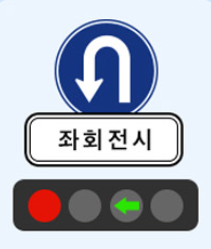
좌회전시
Make a U-turn when the left-turn signal is on
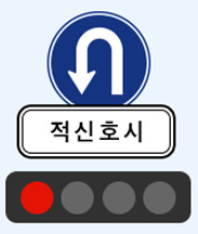
적신호시
Make a U-turn when the traffic light is red
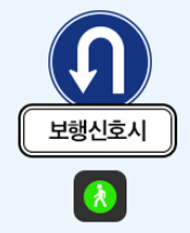
보행신호시
Make a U-turn when the pedestrian signal is on
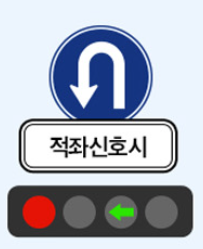
적좌신호시
Make a U-turn when the red light and the left-turn signal are on at the same time
You do not need to memorize every Korean phrase before driving in Korea. The important thing is to know that the Korean text below a U-turn sign may tell you exactly when you are allowed to turn.
So when you see a U-turn sign, do not turn simply because the road looks clear. Check the additional sign below it and wait for the required signal.
The U-turn marking tells you where you can turn. The sign below it tells you when.
🚫 Driving in the Blue Lane Because It Looks Empty
When driving in Korea, you may notice that the regular lanes are congested while one blue lane looks surprisingly empty.
You might think:
“Why not use that lane? It looks much faster.”
But check first. In Korea, a blue lane often indicates a bus-only lane.
In Seoul, bus-only lanes are generally divided into two main types: median bus lanes and curbside bus lanes.
Median bus lanes, which run in the center of the road, operate 24 hours a day, 365 days a year. Regular passenger cars should not use them.
Curbside bus lanes, located along the side of the road, may operate only during certain hours. In Seoul, common operating hours are:
Two solid blue lines → Weekdays, 7:00 AM–9:00 PM
One solid blue line → Weekdays, 7:00–10:00 AM and 5:00–9:00 PM
These curbside bus lanes are generally not operated on Saturdays and public holidays, but rules can vary by road or area. The safest option is always to check the posted signs and operating hours.
You may also see sections where the blue line becomes dashed. These areas may allow regular vehicles to cross the bus lane temporarily when turning right or entering a side street or building.
However, a dashed section does not mean you can continue driving in the bus lane as if it were a regular lane.
So when you see an empty blue lane in Korea, remember:
Empty blue lane → Don’t think “fast lane.” Check whether it is a bus-only lane first.
Look at the lane position, road signs, and operating hours before entering.
If all the other regular cars are avoiding an empty blue lane, there is probably a reason.
If the blue lane is empty, don’t assume it is the fast lane.
🚫 Panicking After Entering a Hi-Pass Lane
When driving on expressways in Korea, you need to pay tolls. You can either pay at a regular toll gate or use a Hi-Pass lane if your vehicle has a Hi-Pass device installed.
If you are renting a car, it is a good idea to check with the rental company first to see whether the vehicle has a Hi-Pass device.
Hi-Pass lanes are usually marked with blue guide lines at toll gates. If your vehicle does not have a Hi-Pass device, you should use a regular payment lane instead.
But what if you realize too late that you have already entered a Hi-Pass lane?
Do not stop suddenly or reverse at the toll gate.
Just continue driving safely through the lane.
If you accidentally use a Hi-Pass lane when entering the expressway, try to remember the name of the toll gate where you entered. When you leave the expressway, use a regular toll lane and explain where you entered so the toll can be calculated and paid.
If you realize only after leaving the expressway that the toll was not paid, there is still no need to panic. Unpaid tolls can be checked and paid later. However, you should not simply ignore them, especially because repeated or prolonged non-payment may result in additional charges.
What if you are driving a rental car?
If you miss a toll while driving a rental car, it is especially important not to forget about it.
Because the vehicle is owned by the rental company, an unpaid toll notice may eventually be sent to the company, which may then contact you for payment.
If possible, keep track of:
the vehicle number + the rental dates + the toll gate you passed through
You can then tell the rental company before returning the car or check whether there is an unpaid toll that needs to be settled.
Taking care of it before you leave Korea can help you avoid an unexpected payment request later.
The key point is simple:
Entered a Hi-Pass lane by mistake → Do not stop or reverse → Keep driving safely → Pay the toll as soon as possible
Wrong Hi-Pass lane? Keep driving. You can fix the payment later.
🚫 Thinking Hazard Lights Always Mean an Emergency
When driving in Korea, you may see the car in front suddenly flash its hazard lights two or three times.
That does not always mean there is a problem with the vehicle.
In Korea, hazard lights are often used not only as a warning signal, but also as an informal way for drivers to communicate with each other.
One common meaning is “Thank you.”
For example, if another driver lets you merge into their lane, you may see drivers briefly flash their hazard lights after changing lanes as a way of saying thanks.
They may also use hazard lights to mean “Sorry” after cutting in a little too closely or causing inconvenience to another driver.
So if the car in front briefly flashes its hazard lights right after changing lanes, it may simply mean:
“Thank you.”
or
“Sorry.”
However, hazard lights are not always a friendly gesture.
On expressways or other fast-moving roads, drivers may turn on their hazard lights when traffic suddenly slows down because of congestion, an accident, or another hazard ahead. In this case, the lights are being used to warn the drivers behind them to slow down.
A simple way to understand it is:
Hazard lights flashing briefly after a lane change → Possibly “Thank you” or “Sorry”
Several cars suddenly turning on hazard lights while driving → Possible congestion or danger ahead
In Korea, hazard lights can be both a warning signal and a short message between drivers.
In Korea, hazard lights do not always mean an emergency. Sometimes they simply mean “Thank you” or “Sorry.”
🚫 Relying Only on Google Maps for Driving
You may assume that Google Maps is all you need for a road trip in Korea.
But here is something that may surprise you:
You would be hard-pressed to find a local driver in Korea using Google Maps for navigation.
Most Korean drivers use local navigation services such as Naver Map, Kakao Map, or dedicated Korean navigation apps instead. So if Google Maps feels strangely less useful once you start driving in Korea, it is not just you.
For years, Google Maps has had limitations in Korea because of restrictions related to high-precision map data. In 2026, the Korean government conditionally approved Google’s request to export high-precision map data, so Google Maps services in Korea are expected to improve over time.
However, as of 2026, those improvements are still being developed and expanded, so it is better not to rely on Google Maps alone when driving.
If you are renting a car in Korea, consider installing Naver Map or Kakao Map before your trip.
Both apps provide driving directions designed for Korean roads, and Naver Map also supports multiple languages, including English.
When driving in Korea, navigation is not just about finding your destination. It is also useful for information such as:
- which lane to use
- where to enter or exit at intersections
- expressway entrances and exits
- real-time traffic conditions
- speed cameras and road alerts
It is a good idea to install Naver Map or Kakao Map and set your preferred language before picking up your rental car. Trying to download or configure a new app after you are already driving on unfamiliar roads can be stressful.
This does not mean Google Maps is useless in Korea. It can still be helpful for finding places and planning your trip, and its driving features may continue to improve.
But if you want to navigate Korean roads the way local drivers do, have a Korean navigation app ready.
Driving in Korea? Don’t rely on just one map app.
Before You Hit the Road
Driving in Korea does not mean learning a completely different traffic system. Most basic driving rules will probably feel familiar.
However, once you get on the road, there are a few Korea-specific rules and driving habits that are worth knowing.
Before you start driving, keep these points in mind:
- When turning right on red, come to a complete stop first and check your surroundings
- If you see a ‘비보호’ sign, turn left only on a green straight-ahead signal after checking oncoming traffic
- Do not look at the U-turn symbol alone — check the signal conditions written below it
- If you see an empty blue lane, make sure it is not a bus-only lane
- If you accidentally enter a Hi-Pass lane, do not stop suddenly or reverse
- Briefly flashing hazard lights may sometimes mean “Thank you” or “Sorry”
- Do not rely only on Google Maps — have Naver Map or Kakao Map ready as well
Most importantly, do not simply copy what the drivers around you are doing. Check the traffic lights and road signs yourself.
Once you understand these few differences, driving in Korea will feel much less unfamiliar.